
The honest answer: yes, but the size of the lift depends on the quality of the path, how connected it is to the wider network, and how long it has been open. The strongest international research, covering nine years and 253,000 property sales in Greater Manchester plus a peer-reviewed Indianapolis study, points to premiums of 3% to 11% for homes within walking distance of a high-quality, well-used shared path. The Te Whau Pathway’s New Lynn section, the Rizal Crossing between Wingate Street and Rata Street, opens before November 2026. Right now, the wider Auckland market is in a holding pattern, and Avondale–New Lynn sales are tracking near or just below CV.
Key Takeaways
What is Te Whau Pathway, and where does it run through New Lynn?
The Te Whau Pathway is a shared walking and cycling route that, when complete, will run from Te Atatū Peninsula on the Waitematā Harbour to Green Bay on the Manukau Harbour. It is the only off-road path connecting Auckland’s two harbours. It follows a traditional Māori taonga waka (portage), the historic canoe-carry route across the isthmus.
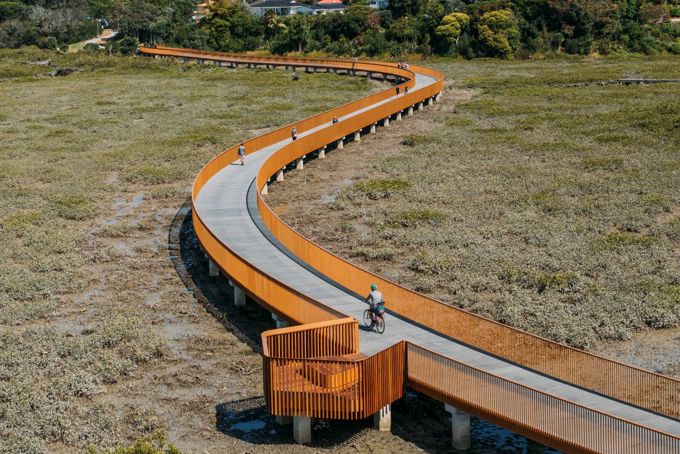
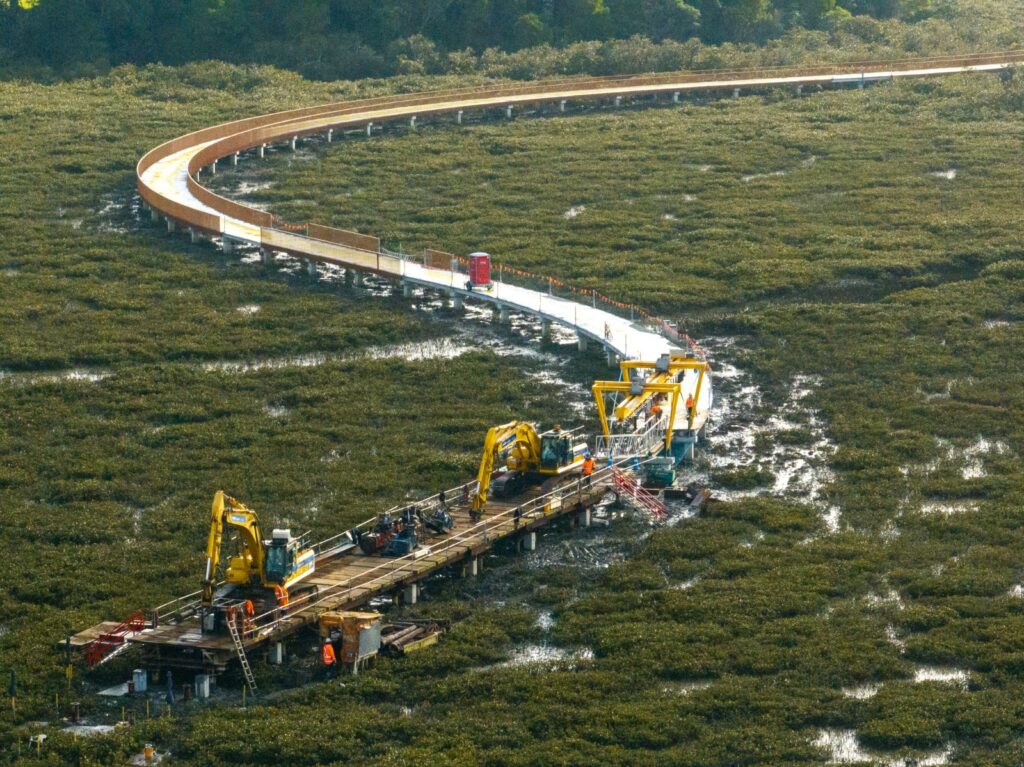
The pathway is being delivered in sections. The Northwestern Cycleway to Horowai Reserve section in Te Atatū South, 1.3km of 4-metre-wide boardwalk and 3-metre concrete paths, opened on 20 March 2026. Construction came in ahead of schedule and under budget. The next stage, the Rizal Crossing, is the section that matters for New Lynn and Avondale homeowners.
The Rizal Crossing is a 400-metre section with a new bridge linking Ken Maunder Park (the Avondale side, near Wingate Street) to Rizal Reserve in New Lynn (near Rata Street). Construction began in April 2026 and is scheduled for completion before November 2026. Funding was confirmed by central government in September 2025, prioritised from savings on the Te Atatū South section.
The full pathway is a partnership between Auckland Transport, Te Kawerau ā Maki, Ngāti Whātua Ōrākei, the Whau and Henderson-Massey local boards, Auckland Council, and the New Zealand Government, delivered alongside the volunteer Te Whau Pathway Environment Trust, which has been championing the project since 2014.
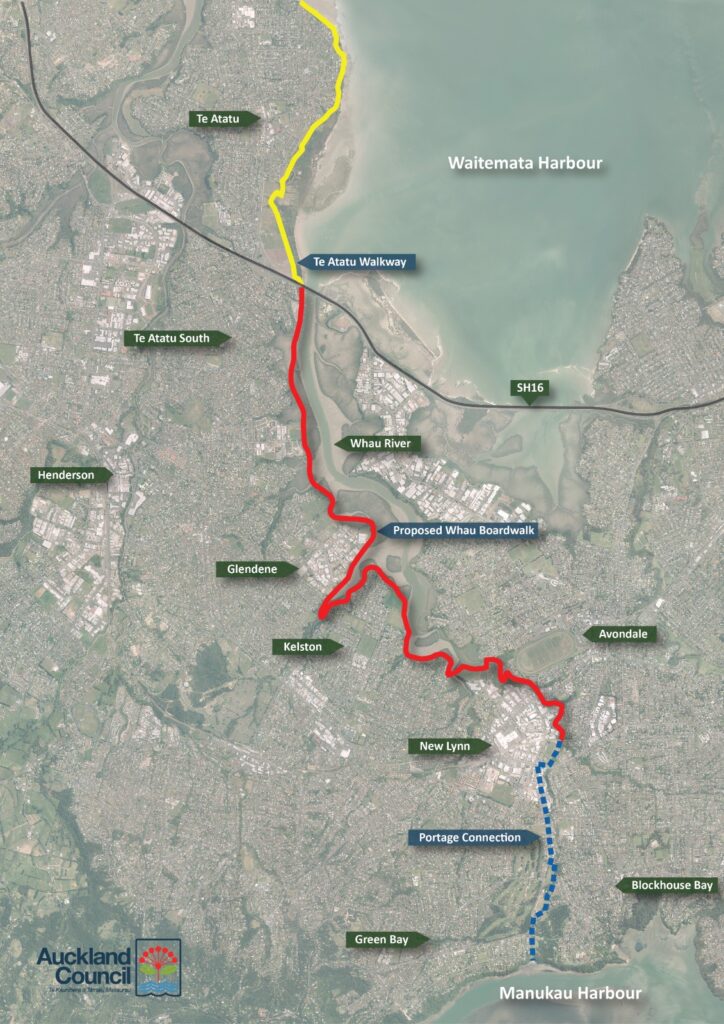
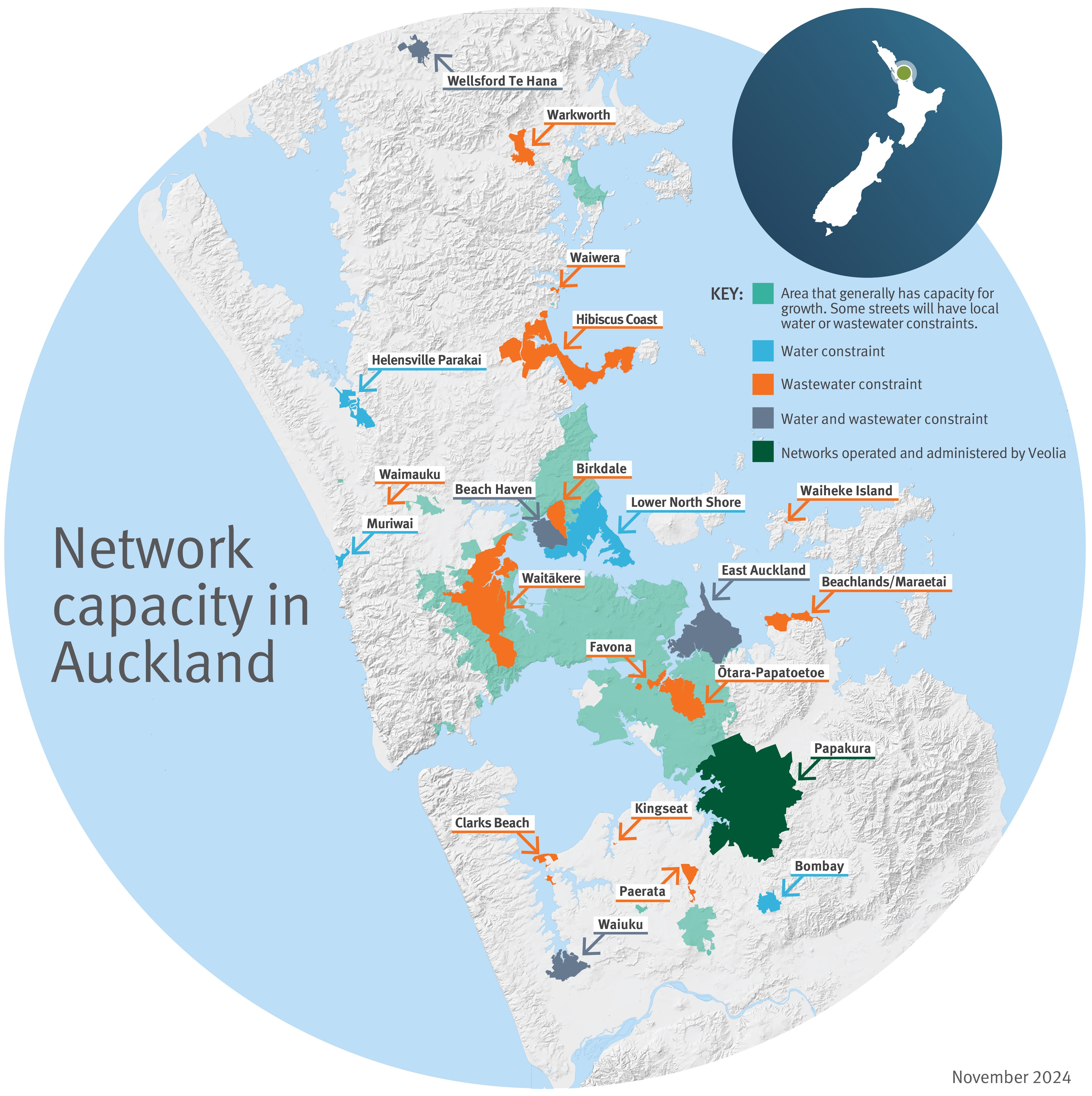
The Te Whau Pathway route, from Te Atatū on the Waitematā Harbour to Green Bay on the Manukau Harbour, passing through New Lynn and Avondale. Map: Auckland Council / Cycle Action Auckland.
What happens to neighbourhoods after a high-quality shared path opens?
The international evidence is consistent: well-built, well-connected shared paths lift values in nearby neighbourhoods, often by enough to materially change how those areas are perceived. The size of the effect varies, and the conditions that drive it matter a lot. Three case studies are particularly relevant for what New Lynn and Avondale can expect.
Indianapolis: the Monon Trail effect
The Monon Trail is the most-studied rail-trail in the United States. A peer-reviewed Indianapolis study by Lindsey, Man, Payton and Dickson, published in the Journal of Park and Recreation Administration in 2004, found homes near the Monon sold for 11% more than the average home in the city. More recent figures cited by Indianapolis officials show homes within half a mile of the trail now command a sales premium of more than $13,000, adding an estimated $115.7 million in value to the roughly 9,000 homes along the route.
The neighbourhood transformation is the more telling part of the story. Broad Ripple, the Monon’s most popular section, was a quiet residential suburb when the trail opened in the 1990s. It is now one of Indianapolis’s most desirable lifestyle neighbourhoods, with the trail used by an estimated 1.3 million people a year. Carmel and Westfield, further north along the trail, have built large mixed-use developments specifically marketed on Monon proximity. Residents who originally feared the trail would damage property values now treat trail access as a top-tier amenity.
The important nuance from the same body of research: less-popular trails in the same Indianapolis study showed no measurable property-value effect. A path’s use matters as much as its existence.
Greater Manchester: 253,000 transactions, 2.8% average uplift
The most rigorous recent study comes from the UK. David Hearne and Erez Yerushalmi, publishing in Environmental and Resource Economics (2024), analysed 253,000 property transactions across nine years in Greater Manchester. Using hedonic and spatial regression models, they found properties closer to the cycle network were worth 2.8% more on average than equivalent properties one kilometre away.
The uplift was much larger closer to the city centre. In central Manchester, homes near a cycle lane were worth 7.7% more than those a kilometre away. The researchers concluded that bicycling infrastructure carries an “unmet demand” reflected in property prices that property developers and policymakers were not pricing in.
What we know from Auckland
Direct New Zealand evidence is thinner, mainly because most major New Zealand shared-path projects are recent. Auckland’s Northwestern Cycleway, the path Te Whau Pathway connects to in Te Atatū, has not been formally studied for property-value impact. But agents working in Pt Chevalier, Westmere, and Grey Lynn now routinely list “minutes to the Northwestern Cycleway” in marketing copy, which would not be commercially worthwhile if buyers did not respond to it.
The Whau River as an amenity is currently under-used by the local property market. Most New Lynn and Avondale listings within 500 metres of the river do not actively market river proximity. That changes once there is a usable, connected pathway along it.
The conditions that drive the effect
Three patterns hold across most of the evidence. First, path quality matters. The completed Te Atatū boardwalk is high-spec: 4 metres wide, well-lit, designed for both walking and cycling, accessible for wheelchairs and walking frames. That meets the bar where premium effects typically appear.
Second, connectivity is what scales the effect. A short, stranded section of pathway delivers far less value than a fully connected route. The Rizal Crossing on its own is useful; the Rizal Crossing as part of a complete Manukau-to-Waitematā route is genuinely transformational.
Third, broader market conditions can swamp pathway effects in the short term. If the Auckland market falls 3% across 2027, a 3% pathway premium gets eaten before it appears in raw sale prices. The premium is real, but it shows up as outperformance versus the wider market, not always as a rising headline price.
The Avondale–New Lynn pre-pathway baseline: what 33 recent sales tell us
The current state of the local market matters more for 2026 vendors than any future pathway premium. Across 33 residential sales in the Avondale–New Lynn catchment between June 2025 and April 2026 (excluding three extreme outliers), the median sale price was $880,000 and the median sale-to-CV ratio was -1.5%. Roughly 53% of sales went below CV; 47% above.
That sits inside a broader Auckland holding pattern, not a New Lynn-specific weakness. Auckland’s House Price Index fell 2.1% in the year to December 2025, and the city remains roughly 19 to 23% below its late-2021 peak. The Avondale–New Lynn catchment is, if anything, performing in line with or slightly better than wider Auckland: not collapsing, just flat.
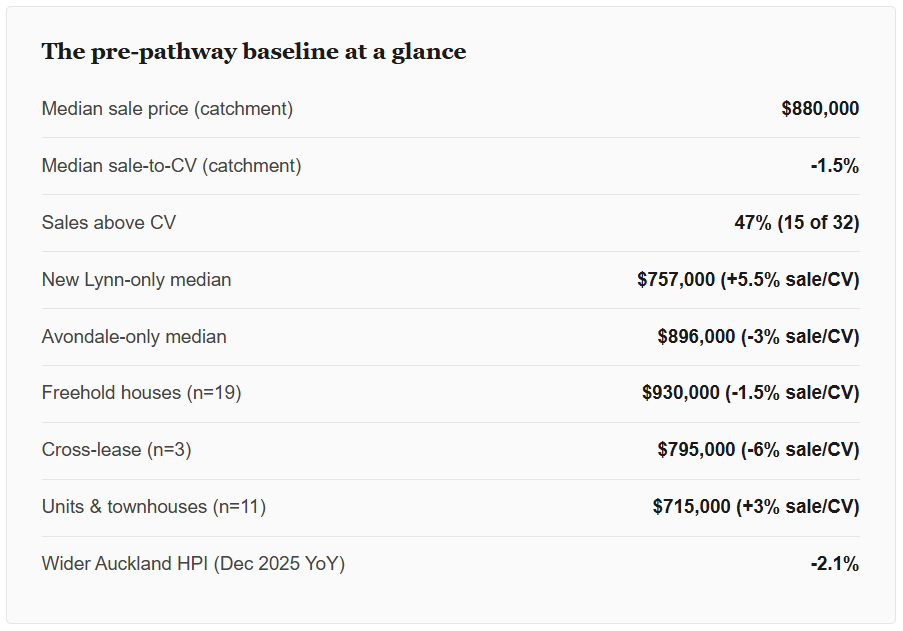
The catchment splits in ways that matter for vendors. By suburb: New Lynn-only median was $757,000 (sale-to-CV +5.5%), driven heavily by a cluster of new 2020s-era townhouses on Binsted Road and Reid Road. Avondale-only median was $896,000, with sale-to-CV of -3%. The composition difference matters: New Lynn’s recent sales are dominated by smaller new builds; Avondale’s by older freestanding homes.
By tenure type: Freehold houses had a median of $930,000 and sale-to-CV of -1.5%. Cross-lease properties had a median of $795,000 and sale-to-CV of -6%. Units and townhouses had a median of $715,000 and sale-to-CV of +3% (the new-build effect, where CVs haven’t caught up).
By era: 1950s and 1960s freestanding homes on bigger sections beat CV consistently. 2010s and 2020s townhouses are mostly trading near or just under CV. Time-split: Median prices in the second half of 2025 ($875,500) and the first four months of 2026 ($882,000) are essentially flat. The market has not moved in either direction.
The point of putting this on record now is so vendors can measure the pathway’s effect after it opens. Bookmark this baseline. When the Rizal Crossing has been complete for 12 months, we will know whether properties near the pathway have outperformed the wider Auckland market, the same way Broad Ripple and central Manchester homes outperformed theirs.
Source: Ray White / Area Specialist sales data, June 2025 to April 2026, Avondale and New Lynn catchment around the future Rizal Crossing route. Outliers excluded: 2/18 Binsted Road (+57% sale/CV, likely outdated CV), 35 Tony Segedin Drive (-23%), 1/58 Riversdale Road (-34%). Wider Auckland figures: REINZ House Price Index, December 2025; Cotality, November 2025.
Which streets are closest to the Rizal Crossing?
The Rizal Crossing connects Ken Maunder Park (Avondale, near Wingate Street) to Rizal Reserve (New Lynn, near Rata Street), with a new bridge spanning the Whau River.
On the New Lynn side: Rata Street and the small streets running off it toward the river. Binsted Road, Reid Road, Queen Mary Avenue, Delta Avenue, and the western end of Wolverton Street. Properties here will be within roughly 400 to 800m walking distance of the new bridge.
On the Avondale side: Wingate Street, Stock Street, Crum Avenue, and the section of Great North Road near Ken Maunder Park. Tony Segedin Drive and Tamora Lane are within the broader walking catchment but slightly further.
The Whau River itself is currently more barrier than amenity for these streets. The only crossings are Great North Road and the rail corridor. The Rizal Crossing changes that. A New Lynn resident on Rata Street will, for the first time, be able to walk or cycle to the Avondale Racecourse, Avondale shops, and (eventually, when more sections open) Te Atatū without going via Great North Road.
What this means if you’re thinking of selling
If you are planning to sell in 2026, plan on the current market, not on a pathway premium that will take 12 to 24 months to show up clearly in sale prices. Median sale-to-CV across the catchment is -1.5%, the wider Auckland market is flat, and most homes are selling near valuation, with some softness on cross-leases and on properties needing work. Realistic pricing, good presentation, and the right marketing campaign matter more than waiting for an amenity boost.
If you can hold until late 2027, the calculation changes. By then, the Rizal Crossing will have been open for roughly 12 months, the broader Te Whau Pathway will have additional sections complete, and any pathway-driven premium will start to appear in the data. Based on the international evidence, a realistic expectation for the Avondale–New Lynn catchment is somewhere in the 3 to 7% range for homes well-placed near the route, if the pathway connects through to a wider network and if Auckland’s broader market has stabilised. A 5% premium on an $880,000 home is roughly $44,000. Meaningful, but not enough to outweigh 18 months of holding costs and market risk for most vendors.
I had a buyer last month who specifically asked about Te Whau Pathway access before they would even view a property. That is the early signal. It will not show up in sales data for another 12 to 18 months, but the demand is already moving.
For homeowners on streets directly adjacent to the route (Wingate Street, Rata Street, sections of Reid Road and Binsted Road), the timing question is sharper. These are the homes most likely to capture the Indianapolis or Manchester-style premium, and the ones where staging, photography, and listing copy should explicitly reference the pathway connection in 2027 marketing.
For cross-lease owners, there is a separate issue worth raising. Cross-lease properties in the catchment are underperforming freehold houses by roughly 4 to 5 percentage points on sale-to-CV. A cross-lease title is a shared land title where multiple owners lease their portion from each other. It limits what you can do without consent from neighbours, and many buyers now actively discount it. If your home is cross-lease and you’re considering a 2027 sale, the conversation about whether to convert to freehold before listing is more valuable than the pathway question.
If you would like an opinion on what your specific home is likely to do in this market, and whether the pathway proximity is material for your address, I am happy to talk it through. Area Specialist sells homes in this catchment, so this is not disinterested advice. But the data is the data, and it is better to make a 2026 or 2027 sale decision with eyes open than to assume an amenity premium will save a poorly-timed listing.
Frequently Asked Questions
Does Te Whau Pathway increase house prices in New Lynn?
The pathway is likely to add a measurable premium based on international evidence. Peer-reviewed studies of comparable shared paths have found premiums ranging from 2.8% to 11% for nearby homes, with the size depending on path quality, network connectivity, and how heavily the path is used. The effect won’t appear clearly in sale prices until 12 to 24 months after the New Lynn section opens. The Rizal Crossing is due to open before November 2026, so meaningful price-effect data won’t exist until late 2027 or 2028.
When does Te Whau Pathway open in New Lynn?
The Rizal Crossing, the New Lynn section linking Wingate Street to Rata Street via Ken Maunder Park and Rizal Reserve, began construction in April 2026 and is scheduled for completion before November 2026. The full pathway, connecting Te Atatū Peninsula to Green Bay across two harbours, will be delivered in further sections beyond this.
Which New Lynn streets are closest to the Rizal Crossing?
The most directly affected New Lynn streets are Rata Street, Binsted Road, Reid Road, Queen Mary Avenue, Delta Avenue, and the western end of Wolverton Street, all within roughly 400 to 800m walking distance of the new bridge. On the Avondale side, Wingate Street, Stock Street, and Crum Avenue are equivalently close.
Should I wait to sell my New Lynn home until after the pathway opens?
For most homeowners, no. A 3 to 5% pathway premium on a typical $880,000 catchment home is around $26,000 to $44,000. Meaningful but not large enough to outweigh 18 months of holding costs and market risk. The exception is homeowners on streets directly adjacent to the route who can comfortably wait until late 2027, and who live in properties most likely to capture the premium. If your circumstances need you to sell now, sell on current fundamentals.
Is the Avondale–New Lynn market a good market to sell in right now?
The catchment is sitting at roughly -1.5% sale-to-CV across recent sales, with the local market essentially flat over the past 12 months. That sits inside a wider Auckland holding pattern. Auckland’s House Price Index fell 2.1% in the year to December 2025. The market is balanced-to-soft, not a strong sellers’ market, but not collapsing either. Realistic pricing and good presentation matter more than waiting for the market to lift.
What does sale-to-CV mean, and why does it matter?
Sale-to-CV is the difference between a property’s sale price and its capital value, the council valuation used for rates. A sale-to-CV of -1.5% means the home sold 1.5% below its CV. CVs are updated every three years and lag the market, so the ratio is most useful as a relative comparison: how is your area performing now versus six months ago, or versus another suburb? It is not a guide to your home’s true market value, but it is a fair signal of local market sentiment.